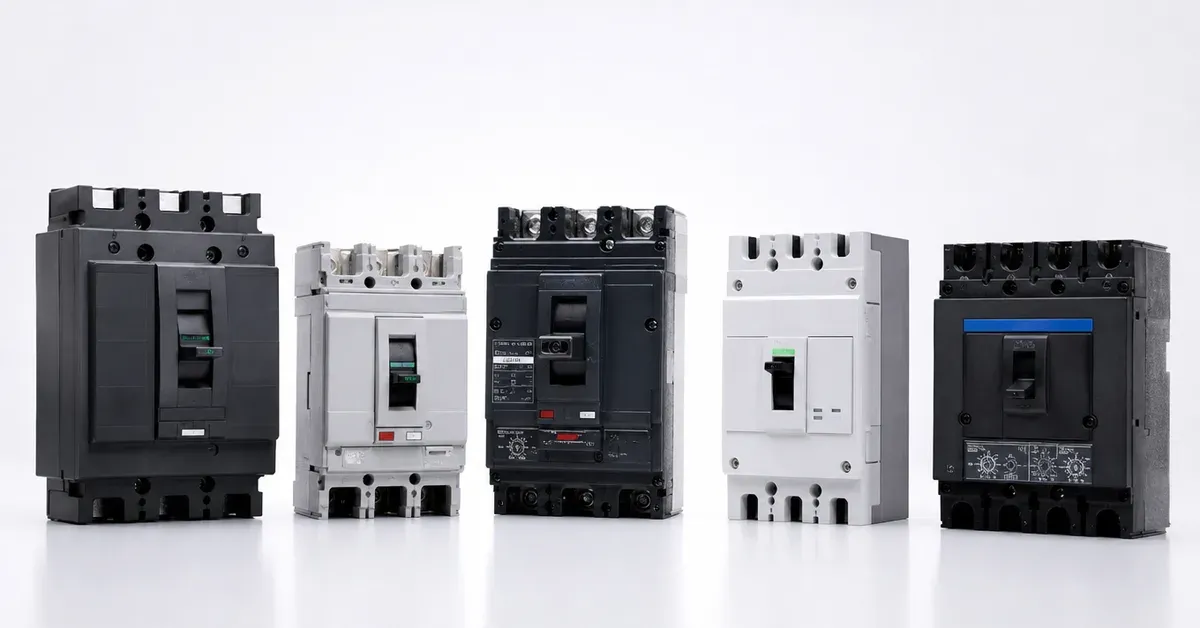
MCCB Cross-Reference: NY STM vs Schneider & ABB
18 August 2026 | NY Circuit Team
Buyers regularly ask us the same question: “Which NY STM breaker replaces a Schneider NSX, an ABB Tmax, a CHINT NM1 or a Siemens 3VA?” This guide explains how professional cross-referencing actually works, what the STM series covers, and where to be careful.
1. Cross-Reference by Application Class, Not by Part Number
Breaker part numbers across brands do not map one-to-one. A correct cross-reference matches six engineering parameters:
- Frame size (shell rating) — the physical current class of the breaker.
- Rated current In — the trip unit setting you need.
- Breaking capacity Icu / Ics — the short-circuit current the breaker can interrupt at your system voltage.
- Number of poles — 1P to 4P.
- Trip unit type — thermal-magnetic or electronic (LSI).
- Mounting and connection — fixed, plug-in or withdrawable; front or rear terminals.
Match all six and the breaker will perform the same protection function. Miss one — usually Icu or trip type — and the substitution can fail a design review or a site inspection.
2. Class Comparison: NY STM vs Global Brands
The table below compares by application class, which is how engineers and procurement teams actually source.
| Application class | NY STM series | Comparable global series |
|---|---|---|
| Thermal-magnetic MCCB, 125A-800A frames | STM6 | Schneider NSX100-630, ABB Tmax XT2-XT4, CHINT NM1, Siemens 3VA1 |
| Thermal-magnetic MCCB, 1250A-2000A frames | STM6 / STMRT-1250 | Schneider NS1250, ABB Tmax XT5-XT7, CHINT NM1-1250, Siemens 3VA2 |
| Electronic trip (LSI), adjustable | STM6E | Schneider NSX with Micrologic, ABB Tmax XT with Ekip, CHINT NM8 |
| Residual-current protection (MCCB + RCD) | STM6L / STM6LE | Schneider NSX with Vigi module, ABB Tmax with RC units |
| DC protection for solar and storage | STM7DC | ABB Tmax PV, Schneider ComPacT NSX DC |
| Smart / IoT metering breakers | STM6ZY / STM6EY | ABB Ekip UP, Schneider PowerTag breakers |
Within each class, STM product records describe thermal-magnetic or electronic trip options and related accessories such as shunt trips, undervoltage releases, alarm contacts and auxiliary contacts. Any standards or test-report claim must be checked against the exact replacement model.
3. What Cross-Reference Does NOT Guarantee
Honesty matters more than a quick sale, so here is what a class match does not give you:
- Mechanical interchangeability. Busbar positions, drilling patterns and terminal layouts differ between brands. A class-equivalent breaker is a functional replacement, not a drop-in part.
- Accessory compatibility. A Schneider rotary handle does not fit an STM6. Order the accessories of the brand you install.
- Selectivity coordination tables. Upstream-downstream discrimination tables are brand-specific and must come from the manufacturer’s test reports.
If your project requires formal substitution documentation, ask us to check the available model-specific documents and dimension drawings before purchase.
4. How to Send Us a Cross-Reference Request
Send us the nameplate data of the breaker you want to replace:
- Brand and model, e.g. “Schneider NSX250F TM200D 3P”
- In, Icu, poles and voltage
- Application (distribution, motor, solar)
- Annual quantity
We can compare the request with recorded options in the STM6 thermal-magnetic, STM6E electronic or STM7 new-energy high-voltage series. Any proposed substitute, document set, sample availability and lead time are fixed for the exact model in the quotation.
See also: MCCB Selection Guide: Frame Size, Breaking Capacity and Trip Curves and MCCB vs MCB.