MCCB vs ACB: Ratings, Breaking Capacity & Cost
2 October 2026 | NY Circuit Team
Every low-voltage project eventually asks the same question: at what point does a molded case circuit breaker stop being the right tool, and an air circuit breaker take over? The answer is rarely a single number — it is a balance of current, fault level, footprint and maintenance. Here is the comparison in practical terms.
Where MCCBs Stop and ACBs Start
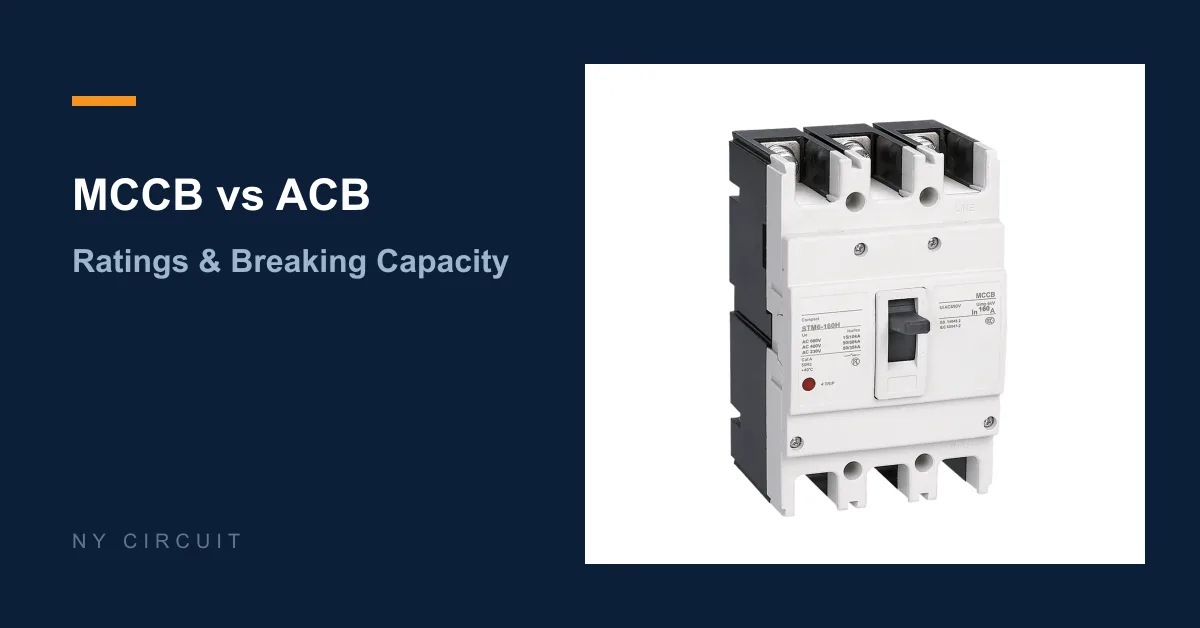
Molded case circuit breakers (MCCBs) are compact, sealed-body breakers that dominate from a few amps up to roughly 2000A frame size. The STM6 thermal-magnetic range covers 10A to 2000A across frames from 125A to 2000A, which is a typical MCCB envelope.
Air circuit breakers (ACBs) are open-frame breakers built for large feeders and main incomers, commonly from 630A up to 6300A. They are larger, serviceable devices with drawout cassettes and motor-charged mechanisms.
The overlap zone between roughly 630A and 2000A is where the decision lives.
Breaking Capacity: Both Go High, Differently
MCCBs reach impressive fault levels — the STM6 family spans 5kA to 100kA Icu at AC400V across its C/S/M/H type codes. ACBs typically sit in the 65kA to 150kA band at low voltage.
The difference is not just the peak number. ACBs are built around short-time withstand (Icw) — holding a fault for 0.5 to 3 seconds so downstream devices can clear it first. That is why main incomers in large installations are almost always ACBs: selectivity across three or four levels of protection is their core job. Electronic MCCBs like the STM6E with 10kA to 25kA Icw can coordinate a level or two, but an ACB coordinates a whole network.
Size, Cost and Maintenance
| Factor | MCCB | ACB |
|---|---|---|
| Frame range | 16A – 2000A | 630A – 6300A |
| Footprint per amp | small | large, needs drawout space |
| Breaking capacity | up to 100kA at AC400V | typically 65kA – 150kA |
| Selectivity | 1–2 levels (electronic models) | multi-level with Icw |
| Service | replace the unit | maintain in place, replace contacts |
| Cost at 1000A+ | lower | higher, plus cassette and spares |
A 1600A distribution main can be done either way. If the board sits close to a big transformer with a high fault level and must coordinate with several downstream feeders, the ACB route is usually correct despite the cost. For a 1600A machine feeder with a dedicated cable run, a high-breaking MCCB like the STMRT-1250 dual-adjustable or a 2000A-frame STM6 often does the job at a fraction of the footprint.
The New-Energy Exception
Solar and storage projects invert the normal logic. The listed STM7 new-energy range runs high-voltage AC (up to AC1140V) and DC (DC750V to DC1500V) inside MCCB frames — voltages where a conventional ACB simply does not apply. When the conversation is about DC strings, battery racks or 1140V PV distribution, you are in MCCB territory by default.
How to Decide, in Order
- Current and voltage — pin the frame size and system voltage first.
- Prospective fault current — calculate or measure it, then pick the breaker level above it with margin.
- Selectivity depth — one or two levels: electronic MCCB. A whole network: ACB.
- Footprint and maintenance — sealed and replaceable, or drawout and serviceable.
- Cost — MCCB wins below roughly 630A, and often to 2000A when selectivity needs are modest.
Tell us your panel design — frame, system voltage and fault level — and we can compare the STM6, STM6E and STM7 options for the MCCB side of your installation, including the C/S/M/H breaking-capacity levels that fit your calculation.
Related reading: MCCB Breaking Capacity: Icu vs Ics and MCCB vs MCB.