How to Choose the Right Micro Switch
17 August 2026 | NY Circuit Team
Micro switches (also called snap-action switches) look simple, but choosing the wrong one leads to field failures, warranty claims and costly redesigns. This guide covers the seven parameters engineers and buyers should check before ordering.
1. Contact Rating (Electrical Capacity)
The contact rating tells you how much current and voltage the switch can reliably make and break. A typical basic micro switch is rated 10A 125/250VAC or 5A 30VDC, but ratings vary widely — from signal-level 0.1A models to 21A heavy-duty versions.
Two rules of thumb:
- AC ratings and DC ratings are not interchangeable. DC arcs are harder to extinguish, so the DC rating is usually much lower.
- Always leave headroom. Running a 10A switch continuously at 9.5A shortens electrical life.
For motor loads, inrush current can be several times the steady-state current — check the inrush capability in the data sheet or ask the supplier.
2. Actuator Type
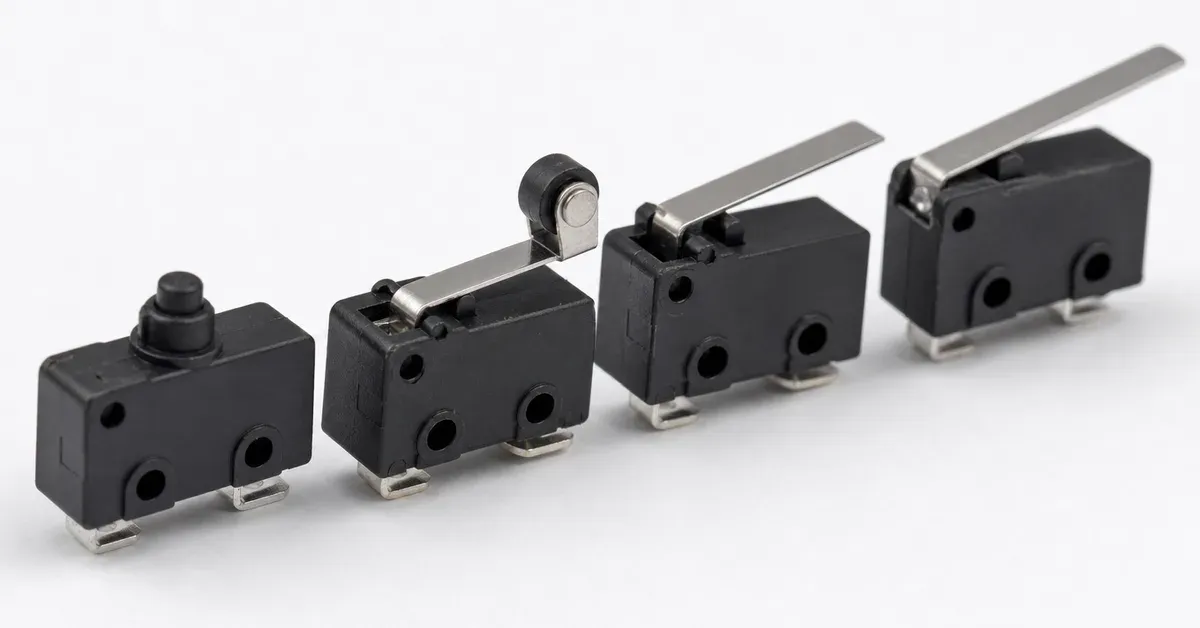
The actuator converts mechanical movement into switch action. Common types:
| Actuator | Best for |
|---|---|
| Button (pin plunger) | Direct pressing, short travel |
| Lever | Long travel, low operating force |
| Roller lever | Cam or slide movement, conveyors |
| Simulated roller | Cost-effective alternative to true roller |
| Leaf / hinge | Detecting large moving parts |
For automation equipment and conveyor limit control, roller lever types last much longer because the roller converts sliding friction into rolling contact.
3. Operating Force and Travel
Operating force (OF) ranges from about 15 gf for sensitive switches to 400 gf or more for robust lever types. Too much force can stall a light mechanism; too little can cause false triggering from vibration.
Check the full travel characteristic: operating position (OP), release position (RP) and movement differential (MD). A small differential gives precise, repeatable switching — important in position detection.
4. Protection Level (IP Rating)
- Standard models are open or lightly dust-protected — fine for clean indoor environments.
- IP67 sealed switches resist dust and temporary immersion. Choose them for automotive, outdoor equipment, marine applications or anywhere moisture appears.
If water exposure is possible, an IP67 model with pre-wired cable usually outlasts a standard model with a connector in field service.
5. Terminal Style
- Solder terminals — PCB assembly
- Quick-connect (faston) 4.8mm / 6.3mm — wiring harnesses, field replacement
- PCB pins — direct board mounting
- Pre-wired cable — sealed switches, harsh environments
6. Mechanical and Electrical Life
- Mechanical life: operations with no electrical load — commonly 1 to 10 million cycles.
- Electrical life: operations at rated load — typically 50,000 to 500,000 cycles.
Electrical life is what matters for your application. Ask for the electrical endurance curve at your actual load, not just the headline number.
7. Market Documentation
Requirements depend on the exact product, intended use and destination. Confirm which rules apply, then request model-matched evidence instead of relying on a logo or a family-level claim:
- EU market — determine the applicable legislation and obtain the EU Declaration of Conformity and supporting technical documentation where CE marking applies
- North America — confirm whether an exact-model UL or cUL listing is required
- China — confirm whether CQC, CCC or another scheme applies to the exact product
- Environmental requirements — request applicable RoHS or REACH declarations and check their model/material scope
The European Commission’s CE guidance explains that CE marking is the manufacturer’s declaration under the applicable EU rules; it is not a universal certificate issued by a central EU body.
Quick Selection Checklist
- Current & voltage (AC or DC?) with margin
- Actuator and mounting style
- Operating force and travel characteristics
- IP rating and temperature range
- Terminals or cable
- Life requirement at your load
- Applicable market requirements and model-matched documents
Still unsure? Send us your application details and reference part number. We can compare candidates in the listed ZHJ range; final suitability should be confirmed from the exact drawing and rating data. Request a model review