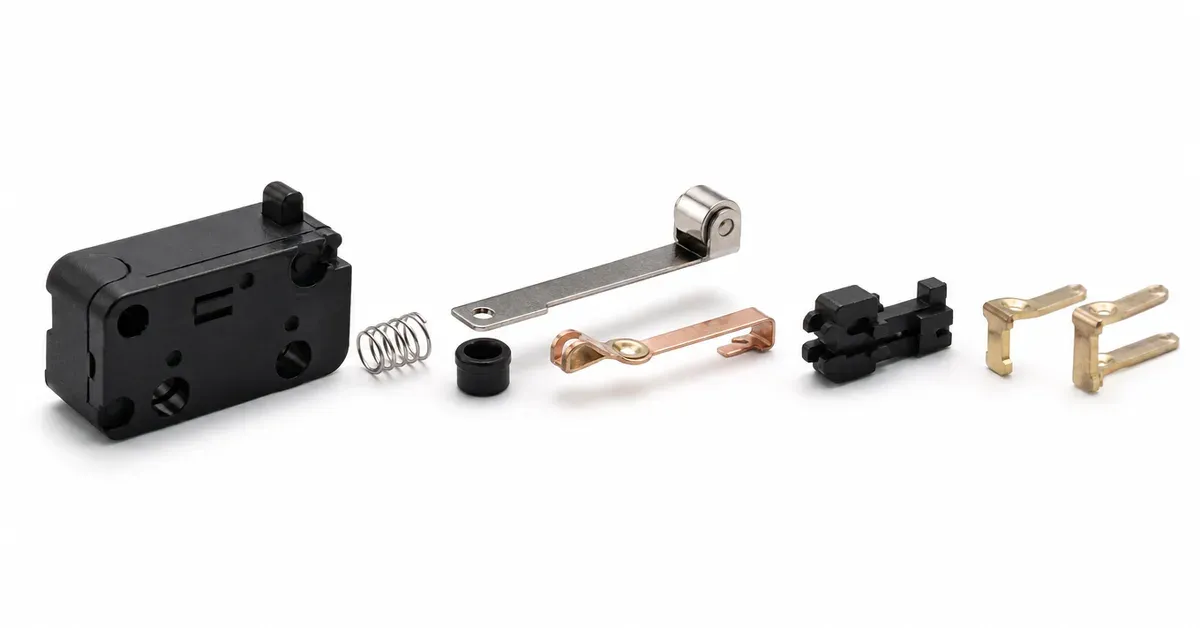
What is a Snap-Action Switch? Working Principle
17 August 2026 | NY Circuit Team
A micro switch is a small switch that changes state with a very small physical movement. Its superpower is the snap action — the contact flips almost instantly, regardless of how slowly the actuator moves. Understanding this mechanism explains why micro switches are everywhere, from microwave door interlocks to elevator position sensors.
The Snap Mechanism
Inside every micro switch is a spring-loaded mechanism that has two stable states. As the actuator is pressed, force builds in the spring. At a precise point — the operating position (OP) — the mechanism snaps across, flipping the contact instantly.
The magic: the snap speed depends on the mechanism, not on how fast you press. Even a slow-moving cam gets a fast, clean switch-over.
Why Instant Switching Matters
- Contact protection. Slow-make/break contacts arc longer. An electric arc erodes contact material and shortens switch life. The snap keeps arcing time minimal.
- Bounce control. Contacts bounce briefly even in good switches, but the snap mechanism keeps bounce consistent and predictable — important for logic circuits.
- Repeatable trip points. The mechanism always releases at the same travel positions, giving precise, repeatable switching for limit detection.
Hysteresis: The Gap Between Make and Break
Snap-action switches deliberately have a difference between:
- Operating position (OP) — where it switches ON
- Release position (RP) — where it switches back OFF
This gap (hysteresis or movement differential) is a feature, not a bug. It prevents the switch from chattering when the actuator hovers near the trip point — imagine a float switch oscillating on a wavy water surface.
For precise position detection you want a small differential; for tolerant sensing of rough mechanical movement, a larger one.
Common Confusion: Micro Switch vs Limit Switch
A limit switch is an application category — a switch that detects travel limits, often built around a micro switch mechanism inside a rugged housing. Not all micro switches are limit switches, and not all limit switches use micro switch mechanisms — but many do.
Choosing the Right One
The three questions that matter most:
- What load must it switch? (voltage, current, AC or DC)
- What moves it, and how far? (actuator type)
- What environment? (standard or sealed IP67)
Our listed ZHJ range covers basic, waterproof IP67 and roller-lever series. Send the reference part number and application details if you want us to compare a candidate model. See the micro switch range