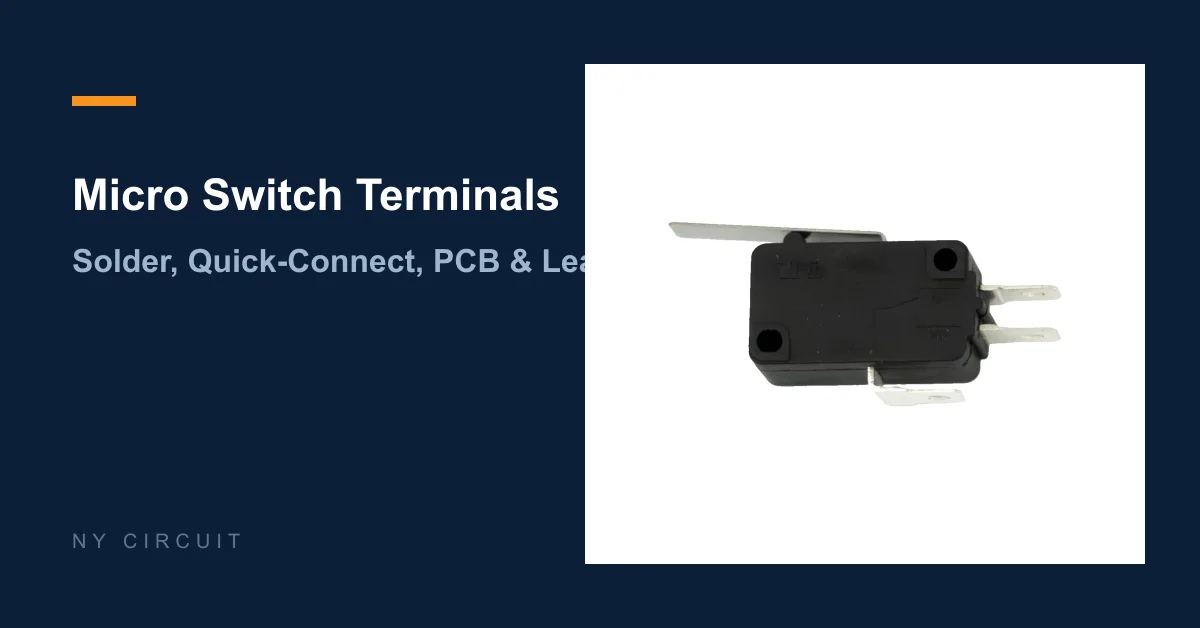
Micro Switch Terminals: Solder, QC, PCB & Wire Leads
2 October 2026 | NY Circuit Team
The terminal is where micro switches fail in the field — not usually because the contact wears out, but because the connection was chosen or made wrong. This guide covers the four terminal families, their strengths, and how to specify the right one on a data sheet.
1. Solder Terminals: The Classic Choice
Solder lugs are the oldest style and still common in appliances, instruments and anything assembled by hand or wave-soldered onto a board.
Strengths: very resistant to vibration once made, low part cost, easy to inspect.
Weaknesses: manual labor on the line, thermal stress on the switch body if the iron dwells too long, and a bad joint can hide under a good-looking fillet.
Solder terminals remain the default for many of the general-purpose DMS micro switches, where the terminal layout is standardized across the series.
2. Quick-Connect Tabs: Built for the Assembly Line
Quick-connect (QC) tabs — commonly 4.8 × 0.5 mm, 4.8 × 0.8 mm and 6.3 × 0.8 mm — mate with pre-crimped harness connectors in seconds. They dominate appliance and automotive production because they remove soldering from the line entirely.
Strengths: fastest assembly, easy service replacement, standard harness tooling.
Weaknesses: the crimp must match the tab thickness; a loose crimp overheats under load. Vibration requires locked or heat-shrinked connections.
When comparing models, confirm the exact tab size on the selection table — a 4.8 mm harness cannot fit a 6.3 mm tab, and mixing them is a common procurement error.
3. PCB Terminals: For Board-Mounted Designs
PCB pins are soldered directly into the board — straight or right-angle, through-hole, spaced to the board layout. They suit control boards, IoT modules and instruments where the switch is one component among many.
Strengths: no harness, no manual wiring, consistent placement.
Weaknesses: the board layout locks you to one footprint, and rework means desoldering.
4. Wire Leads: For Sealed and Field-Replaceable Switches
Pre-wired switches come with molded or attached leads, and they are the natural pairing for waterproof designs — a lead can be potted or overmolded into the switch body, while a tab or solder lug would need its own sealing.
The DMS09 waterproof model lists pre-wired lead options, which suits automotive and outdoor sensor wiring where the connection point sits away from the switch. For wet-environment projects, lead type and length belong in the inquiry along with the model number.
5. Contact Plating: Gold Is Not Always About Looks
Standard terminals use silver contacts, which handle real current well. Gold-plated contacts and terminals are the option for low-level signal circuits — milliamps and low voltages — where silver oxide can make a switch read intermittently.
The general-purpose DMS models list gold-plated terminals as an option, which matters for sensors, logic inputs and anything a PLC reads directly.
6. How to Specify Terminals Without Mistakes
On the selection table, a micro switch family splits into dozens of variants that differ only by terminal, actuator and harness. Specify:
- terminal type and orientation (straight / right-angle)
- tab size for quick-connect, pin pitch for PCB
- lead length, insulation and connector for pre-wired versions
- gold plating when the load is a signal, not power
Send us the model or reference part number with your terminal and actuator requirements, and we can check the matching variant against the DMS selection tables before you order.
Related reading: How to Choose the Right Micro Switch and Waterproof vs Standard Micro Switches.